

The Tech Hustle Handbook
Independent income for technical people, with honest numbers
The measured result
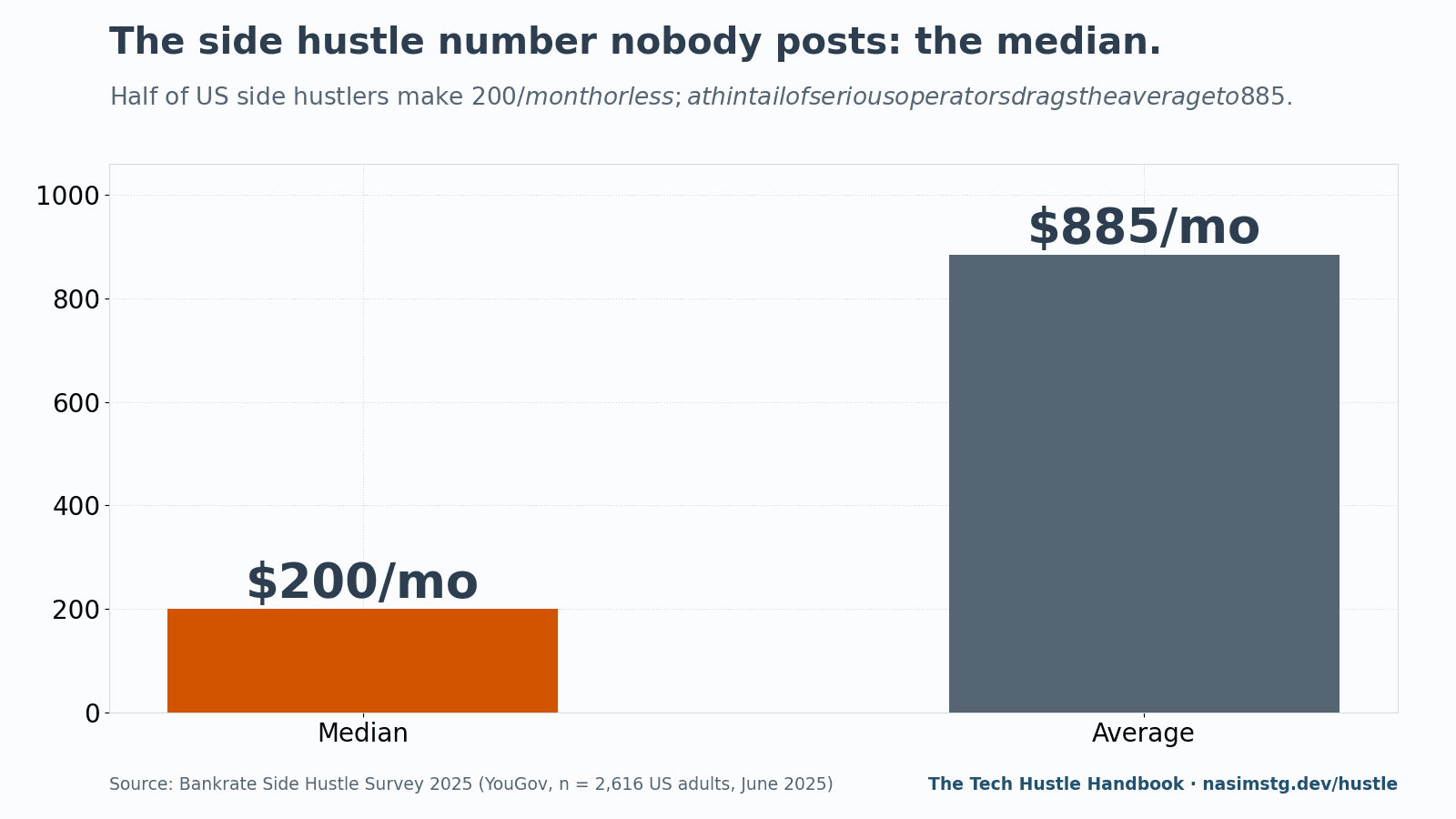
The average side hustle earns $885 a month, but the median is $200 - a gap the book puts in the open instead of hiding behind the average. Its three worked case models show three ways past that median: a digital product reaching $995/month by month six, an automation agency reaching $5,400/month, and a fractional consultant reaching $12,000/month.
$200
median side hustle, vs $885 average
$12,000/mo
modelled fractional-consultant revenue, month 6
5.6M
US independents earning $100k+, +19%/yr
What's inside
- The honest baseline: Bankrate's $200 median vs $885 average side-hustle income, and MBO Partners' data on the 5.6 million Americans earning $100k+ independently.
- Three routes to independent income compared head to head: digital products, automation services, and fractional specialist work, each with real platform fee schedules and a blueprint.
- Three composite worked case models run month by month for six months, an editor's-dashboard product, a dental-practice automation agency, a fractional platform lead, failure months left in on purpose.
- The 30-day first-dollar plan: one route, one offer, one channel, with a fixed skeleton for each ten-day block.
- The replacement math and four quit gates for turning a side income into your main income instead of guessing when to leave a job.
- The unglamorous back half: self-employment tax, sole proprietorship vs LLC vs S-corp, processor vs merchant-of-record fee tables, and the contract clauses that prevent most client disputes.
Table of contents
- Chapter 1
Read this before quitting anything
Frames the book for tech and tech-adjacent readers, whether employed and hedging or freshly laid off, and notes that its core operating chapter is shared verbatim with the companion volume, The Layoff Survival Kit. Cites the industry backdrop: MBO Partners' 73 million independent workers (5.6 million earning six figures, growing 19 percent a year) against Bankrate's $885 average and $200 median side-hustle income, plus the JOLTS hiring freeze that pushes firms toward buying outcomes instead of headcount. Closes with how to use the book: read the route comparison, run the 30-day plan, then use the scaling chapter only once the engine produces signal.
- Chapter 2
The independent revenue engine
The book's central chapter, opening with the Bankrate/MBO Partners honest baseline and then laying out three income routes in full: digital products (Gumroad fee tables, a funnel model, a pricing and launch blueprint), automation services (a worked $1,000-setup/$300-monthly pricing model for local-business intake bots, with a cold-email script), and fractional specialist work (value-anchored pricing and a one-page proposal template). Ends with a route-comparison table, a section on self-employment tax and quarterly estimates, and the 30-day first-dollar plan that structures the rest of the book.
- Chapter 3
Three operators, fully worked
Runs one composite worked operator down each of the three routes for six months: an editor's-dashboard Notion product, a dental-practice intake-automation agency, and a fractional platform-lead audit-to-retainer ladder, with month-by-month revenue tables and the reasoning behind each number. Each case leaves its failure month in on purpose (a launch-audience trough, a slow outreach month, pipeline neglect) and closes with a replication checklist; a closing note ties all three failure months to the same root cause, neglecting the top of the funnel.
- Chapter 4
Scaling to main income
Covers the distance between a working side income and safely making it the main one: replacement math that accounts for health insurance and self-employment tax rather than just matching old take-home pay, four quit gates (revenue, reserve, pipeline, pull), and how to systematize delivery so it doesn't collapse under its own success. Also covers insurance, the legal wrapper (sole proprietorship, LLC, S-corp election, EIN), a fee-and-structure comparison of Stripe, Lemon Squeezy, Paddle, and Gumroad as processor versus merchant of record, and the contract clauses that prevent the most common client disputes.
Who this is for
- Laid-off tech workers who need independent income faster than a job search will produce it
- Employed technical professionals building a side-income hedge against further AI-driven restructuring
- Anyone deciding between a digital product, an automation-services agency, or fractional consulting work and unsure which fits their situation
- Readers who want the arithmetic behind a 'replace my salary' decision instead of a screenshot of someone's best month
The book is written for tech and tech-adjacent professionals, whether still employed and hedging or newly laid off; it assumes no prior business, tax, or legal background and builds the operating, tax, and legal mechanics up from the three routes themselves rather than presupposing them.
How this was measured
The book draws its numbers from two kinds of sources and labels every one so the reader can tell which is which. Measured figures come from cited primary surveys and government series: Bankrate's 2025 Side Hustle Survey (YouGov, n = 2,616 US adults, fielded June 2-4, 2025: average $885/month, median $200/month), MBO Partners' 2025 State of Independence in America (15th edition: 73 million US independent workers, 27.6 million full-time, 5.6 million earning $100,000+, up 19 percent year over year), and BLS JOLTS hires and quits rates (FRED series JTSHIR and JTSQUR, fetched July 11, 2026 by the companion volume's bench/fetch_data.py harness). Platform economics are exact arithmetic against published fee schedules (Gumroad 10% + $0.50 direct / 30% flat on Discover; Stripe 2.9% + $0.30; Lemon Squeezy and Paddle 5% + $0.50 as merchants of record; all accessed July 2026) applied to real price points like $19, $29, and $49. The three case studies in Chapter 3, by contrast, are explicitly labelled composite worked models built from those cited mechanics and fee schedules, not client reports or income screenshots; their month-by-month numbers are stated-assumption arithmetic (visitor counts, conversion rates, demo-to-close rates, a churn event) that a reader can rerun with their own inputs, and the chapter says so directly rather than implying the figures were measured from real operators.
From the preface
One promise kept throughout: where a number comes from a survey you will see the bracket; where it is a worked example you will see the word modelled; and where the honest answer is "no reliable public data exists," the book says so instead of inventing a statistic. That rule costs some rhetorical drama. It is also why you can act on what remains.
Frequently asked
Does this book promise I'll beat the $200 median side-hustle income?
No. It opens with Bankrate's finding that the average side hustle earns $885 a month but the median is $200, and states plainly that beating the median takes deliberate positioning, pricing, and distribution, not luck. The three worked case models show what beating it can look like, but they're modelled, not a promise.
Are the three case studies real client results?
No. The book calls them "composite worked models" explicitly, built from the mechanics and fee schedules cited earlier in the book, not client reports or income screenshots. It leaves each case's failure month in on purpose, and every number that isn't cited to a source carries the word "modelled."
How is this different from The Layoff Survival Kit?
They're companion volumes, and the chapter on the three income routes (digital products, automation services, fractional work) is shared verbatim between both books, so owning one means you already have that chapter. This book's new material is the case-study chapter and the scaling chapter on turning a side income into a main one; the Kit covers the other half: severance, benefits, runway, and the job hunt.
Does the book tell me exactly what to charge for automation services or consulting?
The pricing examples ($1,000 setup + $300/month for intake automation, a $3,000 audit converting to a $6,000/month retainer) are explicitly labelled worked pricing models, not industry survey data, because the book states no reliable public rate card exists for these niches. They're a reasoning tool, not a rate card to copy.
Is this legal, tax, or financial advice?
No. The book states this directly on its copyright page and again in the chapter on entity choice: it covers factual information about taxes, insurance, and business formation, cited to sources like the IRS and SBA, but recommends a licensed professional for any decision with legal or tax consequences.
What's the 30-day first-dollar plan?
A fixed skeleton regardless of route: days 1-3 pick the route and write a one-line offer; days 4-10 build the minimum sellable artifact (product draft, working demo, or two scoped fractional offers) and show it to five people who fit the buyer profile; days 11-20 launch to one channel and put real volume through it, twenty prospect conversations or one community launch; days 21-30 fix the single biggest objection, adjust pricing, and either bank the first dollar or make an evidence-based call to reposition.
Convinced? Get the full book.