

The Layoff Survival Kit
A data-driven playbook for the AI-restructured tech job market
The measured result
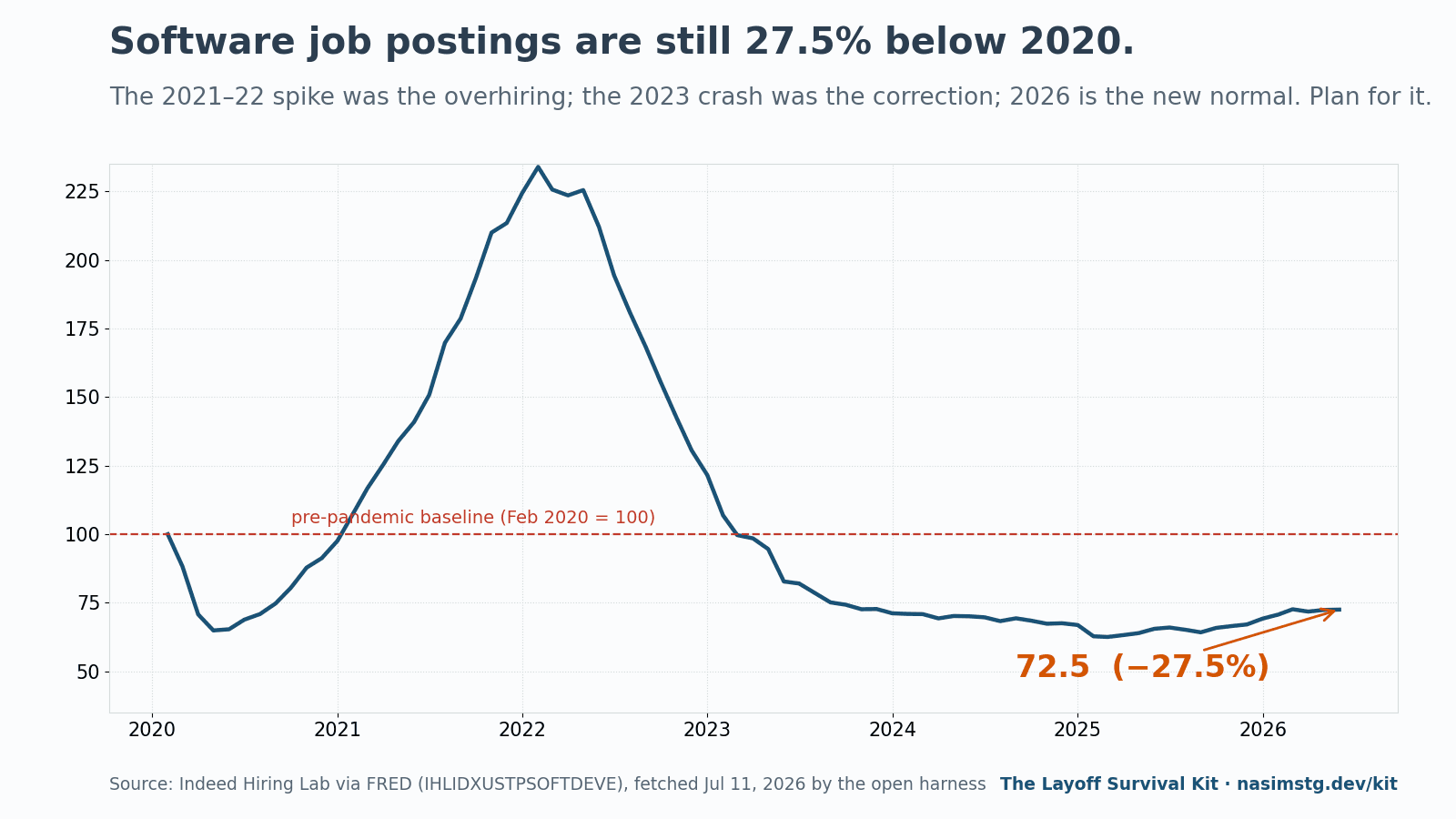
Software job postings sit 27.5 percent below the pre-pandemic baseline and the median job search now runs 11.6 weeks, up from 9.5 a year earlier, yet tech-sector unemployment (2.9 percent) stays below the national rate (4.2 percent): the 2026 market is recomposing, not collapsing, and the strategy has to match that.
72.5
software postings index (Feb 2020 = 100)
11.6 wks
median job search, up from 9.5
37%
of hires from referrals, just 7% of applications
What's inside
- Four public layoff trackers compared side by side, and how AI-attribution claims split into 56 percent of layoff events versus 22 percent of announced individual cuts depending on the denominator.
- A first-48-hours protocol: severance and the OWBPA's 21/45-day review window, WARN Act notice rights, filing for unemployment in week one, and a three-quote COBRA vs. marketplace vs. partner-plan health insurance comparison.
- The runway equation, cash plus net severance plus net unemployment divided by burn, worked through a full household budget and a modelled cash-runway chart.
- A task-audit method for finding low-automation-exposure, high-demand skills, tied to a 62 percent AI-skills wage premium, plus a three-week sprint that produces a public artifact instead of a certificate.
- Three independent-income routes, digital products, automation services, and fractional work, opened with the real median side-hustle income ($200/month) instead of the inflated average.
- The referral arithmetic that replaces volume applying (referrals are roughly 7 percent of applications but about 37 percent of hires), plus negotiation data and word-for-word offer scripts.
Table of contents
- Preface
Preface
Opens with three late-2025/2026 layoffs at Amazon, Oracle, and Meta, companies that were not failing but were pouring billions into AI investment while cutting tens of thousands of roles, and frames the book around that contradiction: a labor-market recomposition, not a collapse. States the book's core rule, every number is labelled measured, cited, or modelled, and previews chapter 6's tracing of the widely repeated but sourceless '75 percent of resumes are auto-rejected' claim. Explains who the book is for and how its chapters map onto the actual sequence of a layoff, with a caveat that the legal and tax content is factual, not advice.
- Chapter 1
The 2026 reality
Establishes the market backdrop with three measured facts: continuing tech layoffs (113,000 to 186,000 in H1 2026 depending on which of four trackers you use), a tech-sector unemployment rate (2.9 percent) below the national rate (4.2 percent), and a frozen JOLTS market where hires and quits rates sit near historic lows. Shows how AI-attribution claims split into 56 percent of layoff events versus 22 percent of announced cuts depending on the denominator, and walks through Amazon, Oracle, and Meta's cuts as one pattern, workforce recomposition rather than shrinkage. Closes by tying postings data (27.5 percent below the pre-pandemic baseline), search-duration data (median 11.6 weeks), and the JOLTS freeze directly to the strategies of the following chapters.
- Chapter 2
The first 48 hours
A protocol for the two days after a layoff: what you're legally owed versus what severance offers as a negotiated exchange, the OWBPA's 21-or-45-day review window plus 7-day revocation for workers 40 and over, and the WARN Act's 60-day notice requirement for mass layoffs. Covers reading the separation agreement in two passes (money, restrictions), a template counter-ask email, filing for unemployment insurance in week one, and comparing COBRA, the marketplace, and a partner's plan for health coverage inside their 60-day windows. Ends with data-handling and conduct rules and a visual 48-hour timeline checklist.
- Chapter 3
The runway
Converts finances into one number, months of runway, through a burn-rate exercise (keep/pause/cut categories) and the runway equation: liquid cash plus net severance plus net unemployment, divided by post-trim monthly burn. Works a full example household (trimming burn from $4,830 to $4,310, yielding 9.1 months of runway) and a modelled cash-curve chart showing how $1,300/month of side income pushes insolvency past the one-year mark. Covers the order to spend pooled money in, cash and severance first, retirement accounts last, and sets up a weekly 15-minute dashboard review that gates later decisions.
- Chapter 4
The reprogramming
Gives a method for auditing your actual skills: listing 15 to 20 concrete accomplishments and grading each on automation exposure and market direction to surface low-exposure, high-demand capabilities your old title buried. States the market's wage data, a 62 percent AI-skills wage premium, postings for AI skills growing roughly eight times as fast as the overall market, 71 percent of software-posting growth going to senior roles, and argues the premium goes to people who apply AI to a domain they already know. Lays out a three-week sprint (consume, build, publish) for closing the gap with a public artifact, then covers pipeline cadence and burnout management for a search that runs months, not days.
- Chapter 5
The independent revenue engine
A chapter shared verbatim with the companion volume, The Tech Hustle Handbook. Frames independent income with the honest baseline that the median US side hustle earns $200/month even though the average is $885, while 5.6 million full-time independents earn six figures. Details three routes, digital products (with Gumroad's exact fee schedule and a sales-funnel model), automation services for small businesses (a stated worked pricing model, not survey data, plus a cold-email template), and fractional senior work, then gives a comparison table and a rule to run exactly one route for the first sixty days. Closes with self-employment tax mechanics (15.3 percent SE tax, quarterly estimates) and a 30-day first-dollar plan.
- Chapter 6
The job hunt, rebuilt
Argues volume applying fails on arithmetic given a frozen hiring market, then debunks the widely repeated '75 percent of resumes are auto-rejected by ATS' statistic, tracing it to an untraceable 2012 vendor claim, and cites the real mechanism instead: 88 percent of employers admit their own screening filters exclude qualified candidates. Presents the referral arithmetic, referrals are roughly 7 percent of applications but about 37 percent of hires, with a template referral-ask email and a four-sentence cold outreach note to hiring managers. Ends by treating the job hunt as a pipeline with weekly input targets reviewed every Friday.
- Chapter 7
The offer
Opens with negotiation data from three sources: about seven in ten US workers don't ask for higher pay, but two-thirds of those who do get some improvement, and 87 percent of people who counter get at least part of what they asked for. Walks through building a total-compensation table, base, bonus, equity, benefits, PTO, severance terms, rather than negotiating on base salary alone, gives a three-sentence counter script, and covers exploding offers and running multiple simultaneous processes. Closes on how a working independent-income engine from chapter 5 changes negotiating leverage.
- Chapter 8
Conclusion: the 90-day plan
Compresses the book into a 90-day calendar: stabilize (days 1-7), measure runway (days 8-14), re-aim skills in parallel (days 8-30), then run the job hunt and revenue engine together (days 15-45), with decision gates at day 30, 60, and 90 that recompute runway and trigger austerity or repositioning if it falls under three months. Restates the book's throughline, replacing unmeasured dread with measured, controllable inputs, and points to the companion volume, The Tech Hustle Handbook, for readers who want to expand chapter 5 into a full operating manual.
Who this is for
- Tech workers laid off in 2025-2026 who need an immediate, sequenced plan for the first weeks
- Employed tech workers who want to stress-test their runway and repositioning before a layoff happens
- Anyone tired of unsourced career-advice statistics who wants claims labelled measured, cited, or modelled
- Workers weighing independent income, freelance, digital products, or fractional work as a parallel or alternative track
Assumes general comfort with numbers and spreadsheets, not programming; where a tactic benefits from code, a no-code path is given alongside it. The legal, benefits, and tax content (severance law, COBRA, unemployment insurance, WARN, OWBPA) is written for the United States, citing DOL, EEOC, IRS, and state programs; the book states the sequence still applies elsewhere but every citation and rule changes.
How this was measured
The book's three charted series are pulled directly from FRED, the Federal Reserve's public data portal, by a Python script (bench/fetch_data.py) shipped with the book and re-runnable with only the standard library: Indeed Hiring Lab's US software-development postings index (series IHLIDXUSTPSOFTDEVE, daily, indexed to 100 on February 1, 2020), the BLS median duration of unemployment (UEMPMED, monthly, seasonally adjusted), and the JOLTS hires and quits rates (JTSHIR and JTSQUR, monthly, seasonally adjusted). The harness was run on July 11, 2026 and wrote both the TikZ/pgfplots data files behind the figures and a results.json recording the fetch date plus each series' first, last, minimum, and maximum values, so nothing between download and chart is typed by hand; per results.json, the postings index ran from 99.98 at the February 2020 baseline to a peak of 233.87 in February 2022 and down to 72.51 by June 2026. Every other statistic in the book, layoff-tracker totals, wage premiums, referral rates, negotiation outcomes, insurance costs, is either a bracketed citation to a named primary source (BLS, EEOC, DOL, KFF, Pew Research, PwC, MBO Partners, Bankrate, Gumroad, Stripe, the IRS, and others, all verified against the original in July 2026) or explicitly labelled a worked model, such as the chapter 3 household budget or the chapter 5 automation-services pricing example, built from stated assumptions rather than survey data.
From the preface
The layoff was a thing that happened to you. Nearly everything after it, this book has tried to show, is a thing you do. Run the protocol, trust the numbers, adjust at the gates, and let the median take care of itself.
Frequently asked
Is this legal or financial advice?
No. The book states plainly that it contains facts about severance, unemployment, health coverage, and taxes, cited to the agencies that administer them, but facts are not advice; rules differ by state and by contract and change over time. For any decision with legal or tax consequences, the book recommends paying for an hour of a lawyer's or CPA's time.
Is the content specific to the United States?
Yes. The severance, WARN Act, OWBPA, COBRA, unemployment insurance, and tax content is written for the US, with citations to DOL, EEOC, IRS, and state programs. The preface notes that if you're elsewhere, the sequence of the book still applies, but every citation and rule changes.
How reliable are the layoff numbers, since trackers disagree so much?
The book is upfront that they disagree: four public trackers put H1 2026 tech layoffs between about 113,000 and 186,000 depending on inclusion rules, and it shows that spread in a table rather than picking a favorite. It also separates the AI-attribution claim into two real but different figures, 56 percent of layoff events versus 22 percent of announced individual cuts, so you can see how that kind of statistic gets inflated in headlines.
Does the book promise I'll replace my salary with a side hustle?
No, and it opens the independent-income chapter with the opposite: a 2025 Bankrate survey found the average side hustle earns $885 a month, but the median is $200 a month. The book argues a laid-off tech worker can beat that median with deliberate positioning, but treats the median as the honest starting point, not a footnote.
What if I wasn't laid off, just worried about it?
The book runs in the order a layoff actually unfolds, but the preface says workers who manage their career as if a layoff could happen any year are right to, given chapter 1's data on continuing cuts inside a low-unemployment sector, and chapters 3 through 7 apply just as well as a pre-emptive audit.
Is there a companion book?
Yes. Chapter 5, The Independent Revenue Engine, is shared with a companion volume, The Tech Hustle Handbook, which expands that chapter into a full operating manual for making independent income a primary path, including scaling decisions this book only gestures at.
Convinced? Get the full book.